Welcome!

This summer I am taking on the country with Harvey (My family's rv), my family, and dog Timber. And of course, my camera (an Olympus Pen-Ep3) and many, many, many books. Join us on this adventure through my pictures and writings.


Thursday, August 2, 2012

If Isn't Here It Doesn't Exist (Salina, Kansas Post)

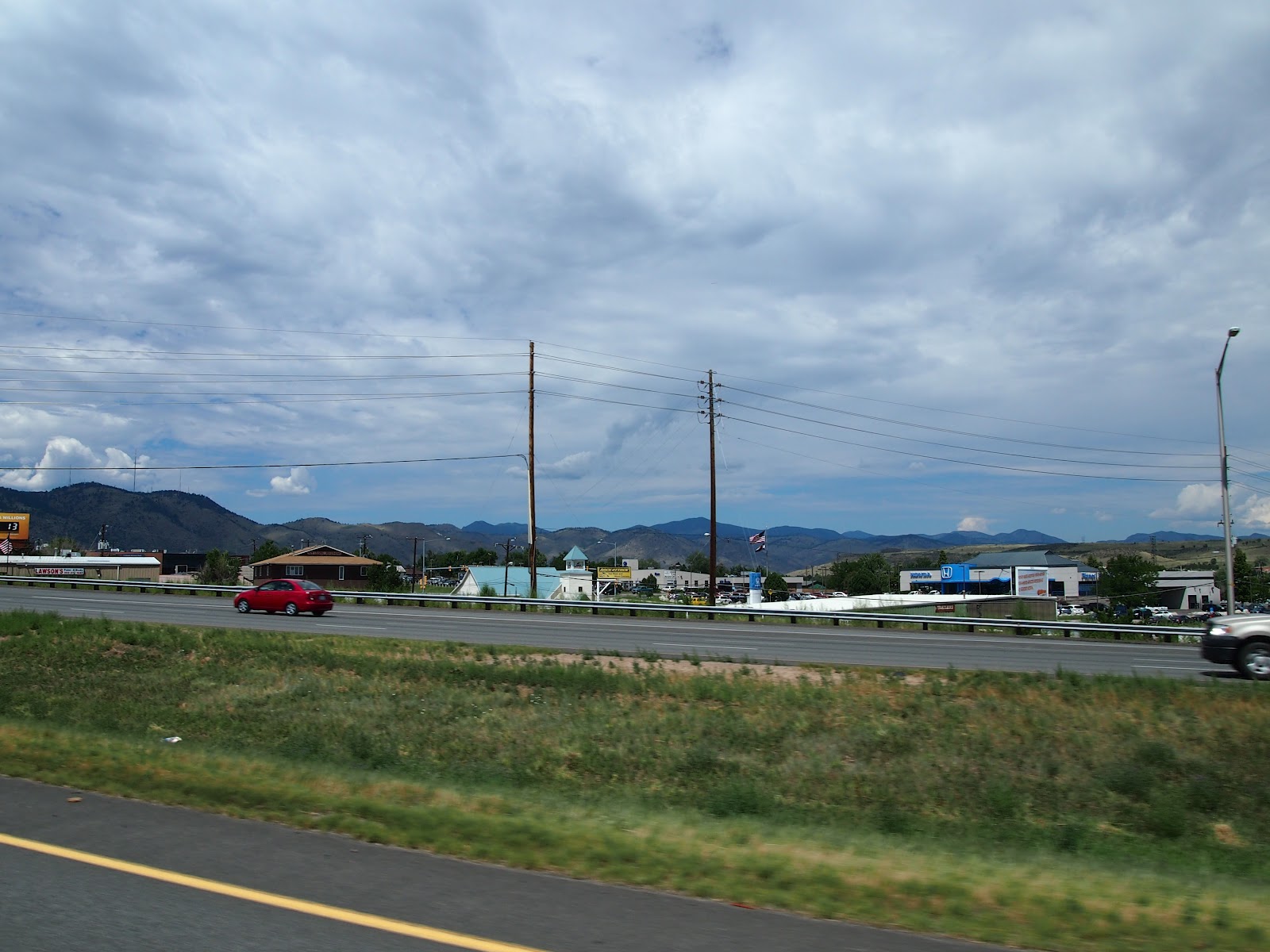
Get a good look at these mountains, these are probably the last we will be seeing until we see the Appalachian Mountains close to home.  

What was on the other side of the road when I took the last picture.  
 Mom was reading the map and Triple A guide book and discovered the World's Wonder View Tower and museum.  Eager for a chance to stretch our legs, we decided to visit.  I knew it would be an interesting place when the sign for the town's business district was down a dirt road.
The tower was built by Colorado's P.T. Barnum, Charles W. Gregory in the highest point between Denver and New York, an elevation of 5,715 feet.
The World's Wonder View Tower in Genoa, Colorado

The museum adjacent to the tower.  The slogan here is: "If it isn't here, it doesn't exist."   You will soon discover why.  

The wishing well with a plaque that says, throw in three coins and your wish may come true.  

Proven by Ripley, from the top of the tower, you can see six states -  Nebraska, Kansas, Colorado,  Wyoming, South Dakota, and New Mexico.  

The current owner of the tower and museum, Jerry Chubbuck delighted us with his quiz, Guess What, where he showed us many unusual items, and we tried to guess their function.  Nope, this object isn't a practical joke for April Fool's Day, its a potato peeler.   

There are 21 different rooms all like this one, all remarkably well kept by Jerry.  

A giant geode with a dinosaur bone in front of it.  

A two headed calf.  

I just climbed these ladder like stairs to reach the top of the tower.  
 The view off the tower.  I couldn't identify which state was what, can you?


Just one of the many interesting objects within the museum.  

This massive fireplace had a rock from every state in the United States, but it was too big for me to get a picture of all of it.  Here is part of it!

Millions and Millions of Meat Grinders.  

Nope, these aren't the same meat grinders, there were more than my first picture.  

Over 50,000 different bottles like these.  


Kansas.  Endless fields of wheat and corn.  


Of course when I try to take a picture of the sunset, the only trees in Kansas show up.  

Without the trees. 


The gorgeous moon was a pinkish orange.   
Kansas does have a pretty night sky and moon.  
 I really understand the saying man with one watch always knows the time, man with two never knows for sure, because with all our time travelling through the different time zones, we have clocks from a variety of time zones.  We have a clock in pacific time, one in mountain time, and several in central time, and one that is in the Vladivostok Russian Time Zone.  (It currently says its 4:20 in the morning.)  Yesterday, I could't tell you what time it was at all.

Amy

Wednesday, August 1, 2012

The Prettiest Part of Colorado (Marble, Colorado Post)

 Sadly, our trip will shortly be coming to an end.  We have been heading home since the Hoover Dam, but the realization really just hit yesterday, as we knew it would be a day of driving, without much stopping.  However, we had one consolation - we were driving through the prettiest part of Colorado according to my Dad and several others we talked to.


The Summit of Molas Pass, where these next few pictures were taken, has an elevation of 10,899 feet.

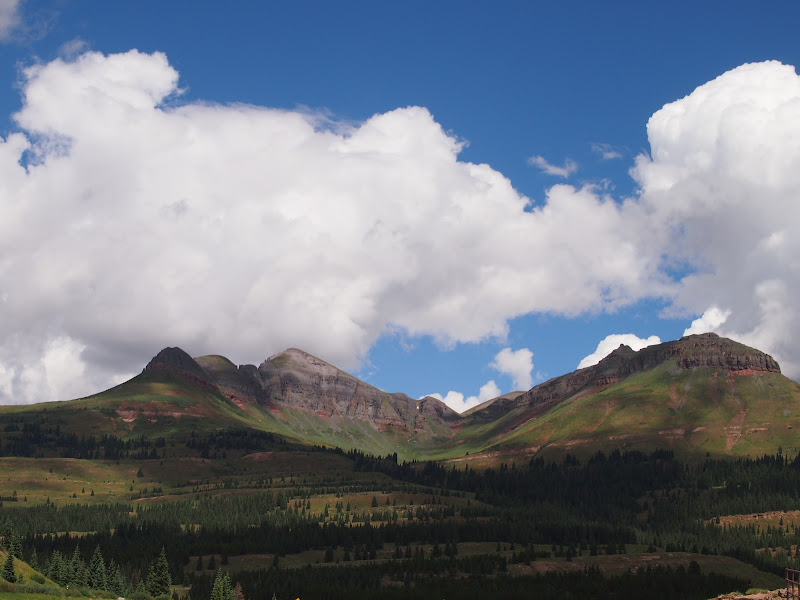
Colorful wildflowers in front of the San Juan Mountains.  

According to a sign, I was taking some of the cleanest, freshest air in the United States into my lungs!

I originally attempted to take this picture without the butterfly, but it flew into my picture at just the last second.   I ended up liking this picture with the accidental butterfly better than my original!

I offered to take a picture of a group of people, and in turn they took this picture of me.  
 These were taken after we left Molas Pass.

Nestled in the mountains is the old mining town of Silverton.  

Colorful rocks on the mountain.  

Another storm is brewing!

We pulled over in a turnout during the thunderstorm, because we were on the Million Dollar highway with many curves and steep grades.  Timber doesn't like thunder and lightning, so this is her protection from it.  A pillow in Mom's lap wearing her protective inner-tube (a neck pillow). 


A waterfall.
An adjacent, wider waterfall.  

Timber, always curious, jumped up on her back legs and looked to see what everyone was looking at .
The storm cloud is covering the mountains just visible minutes before.  

Timber was tired after all the excitement and "borrowed"  Karen's bunny.  


Until Later,
Amy


Achieving Dreams (Mesa Verde National Park Post)

While I was reading my earlier post, on the South Rim of the Grand Canyon, I realized I forgot to put in which rim I like better.  I do like the North Rim better.  My reasoning for that statement is in the other post if you care to seek it.  

Going to Mesa Verde (Green Table in Spanish) has been a goal of mine since I first learned about the Anasazi in third or fourth grade.  
The Anasazi People are known by archeologists as Ancestral Puebloans, but both names refer to the same group.  I learned about these cliff dwelling people as Anasazi, so that is how I am going to refer to them. Although the Anasazi are most known for their homes in the cliff faces, they did not always live this lifestyle.  Originally nomadic, these ancestors of the cliff dwellers were called Basketmakers, because of their skill in weaving.  Farming on top of the mesas in which the fertile soil existed had begun to replace hunting and gathering.  They lived in pit houses on the mesas.  The Anasazi began making pottery and using the bow and arrow instead of the atlatl or spear.  These pit houses would later become kivas.  By 750 AD, they began building homes above ground using wooden poles and adobe.  By 1000 AD, they began to construct structures out of stone masonry.  The Anasazi also began to move off the mesas and use those mostly for farming. Between 1100 and 1200, which archeologists refer to as the Classic Period, the Anasazi began moving into the cliff dwellings Mesa Verde is famous for.  Near the end of the 1200s, a drought occurred in the four corners area, and the Anasazi began to leave their cliff dwellings and migrate south.  Archeologists are unsure of why exactly they left as they had no written language, but several theories exist.  One is the drought.  Another is that they exhausted the area's supply of resources.  
An early gutter!  This spout-like drainage pipe from the roof was probably used to collect rainwater.   

This was at one time a reservoir.  

The Balcony House Tour
Looking up at Balcony House

We had to climb this ladder to enter.  However, the Anasazi who lived here crawled in and out of the tunnel we exited through.  In other spots, hand and foot holds were used.  

Walking around the courtyard.  

Through a window.  


A kiva, such as this one, would be used for ceremonies or family gatherings.  It would have a flat roof, and a ladder down the chimney, a hole in the roof, to enter.  It would also have a keyhole like opening that was a ventilation shaft.  The brick wall to the left of the fire pit would prevent the air from the vent from blowing directly on the fire and would circulate it around the room.    

The Cliff Palace Tour.  
Cliff Palace from above.  Cliff Palace was actually not used as a palace.  It was named for its massive size.  It is the biggest cliff dwelling in Mesa Verde, about 150 rooms.   


This structure was 4 stories tall!
A storm was coming!  The views were the most dramatic from the highest part of the park at the fire watchtower, built help discover fires and prevent them before they cause too much damage.


Amy